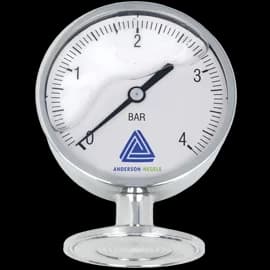
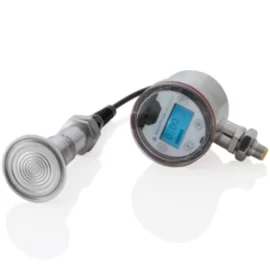
A comprehensive product ranges from robust, low-cost pressure transmitters for standard process requirements up to intelligent pressure sensors with high-end equipment for full automation of even the most difficult processes always offers the best possible and most economical device for every requirement, every process and every application.
This allows to meet requirements for special performance characteristics:
High process temperatures: Special high temperature pressure sensors allow process temperatures up to 250°C
High pressure: Some applications, such as homogenizers, work with very high pressures. Anderson-Negele offers pressure gauges suitable for pressures up to 1000 BAR.
Overpressure resistance: In some processes, strong pressure surges can occur, which can damage the pressure sensor. In this case a sensor with a high overpressure resistance should be used. At Anderson-Negele, variants with an overpressure resistance of 40 BAR are available.
Field Repair: Modular pressure sensors with Smart Replace Design allow easy on-site replacement of components, simplifying spare parts inventory and increasing sensor availability.
Temperature compensation: With hydrostatic level measurement, a temperature drift can lead to inaccurate output values. With Anderson-Negele sensors the deviation due to the temperature effect is up to 10 times lower than with conventional pressure sensors.
Turndown: Even with turndown up to 10:1, the measurement accuracy at Anderson-Negele remains up to 0.15% due to the use of the calibrated measurement range as reference.
Pressurized tanks: For pressurized tanks, a differential pressure sensor with two sensor stems is the best solution for high-precision level or volume measurement.
Small tube diameters: the larger the diaphragm diameter, the higher the measuring accuracy. However, this becomes a problem with very small pipelines. This can be overcome by process adaptation with the CPM and CPM Mini adapter systems. These enable pressure sensors with standard diaphragms even for pipe diameters of only ¼”. Further information can be found in the product category Process adaptations.

'%3E%3Cpath d='M0 0H360V240H0V0Z' fill='%23A1A8C2' fill-opacity='0.18'/%3E%3Cpath d='M260 59C260 78.33 244.33 94 225 94C205.67 94 190 78.33 190 59C190 39.67 205.67 24 225 24C244.33 24 260 39.67 260 59Z' fill='%23A1A8C2' fill-opacity='0.25'/%3E%3Cpath fill-rule='evenodd' clip-rule='evenodd' d='M319 250H417L291.485 124.485C286.799 119.799 279.201 119.799 274.515 124.485L234 165L319 250Z' fill='%23A1A8C2' fill-opacity='0.25'/%3E%3Cpath d='M311 250L-89 250L102.515 58.4853C107.201 53.799 114.799 53.799 119.485 58.4853L311 250Z' fill='%23A1A8C2' fill-opacity='0.25'/%3E%3C/g%3E%3Cdefs%3E%3CclipPath id='clip0'%3E%3Cpath d='M0 0H360V240H0V0Z' fill='white'/%3E%3C/clipPath%3E%3C/defs%3E%3C/svg%3E%0A)